
A common misconception is that a transaction simulation makes a DeFi transaction safe. It does not. Simulation is better understood as an inspection of what a transaction appears likely to do before the wallet asks you to sign it. That distinction matters because smart-contract interactions are not ordinary payments. A single approval, swap, bridge, or collateral update can change several permissions and balances at once, often across contracts that the user has not read.
Rabby’s browser extension is designed around this pre-signing inspection step. Instead of treating a wallet as a passive key holder, it presents transaction details, warnings, and simulated outcomes as decision support. That is a meaningful evolution from earlier browser wallets, where users often saw a contract address, a method name, and a request to approve without a clear view of the economic consequence. Yet the simulation remains an estimate produced under particular network conditions. It improves visibility; it does not replace judgment, contract review, or operational discipline.
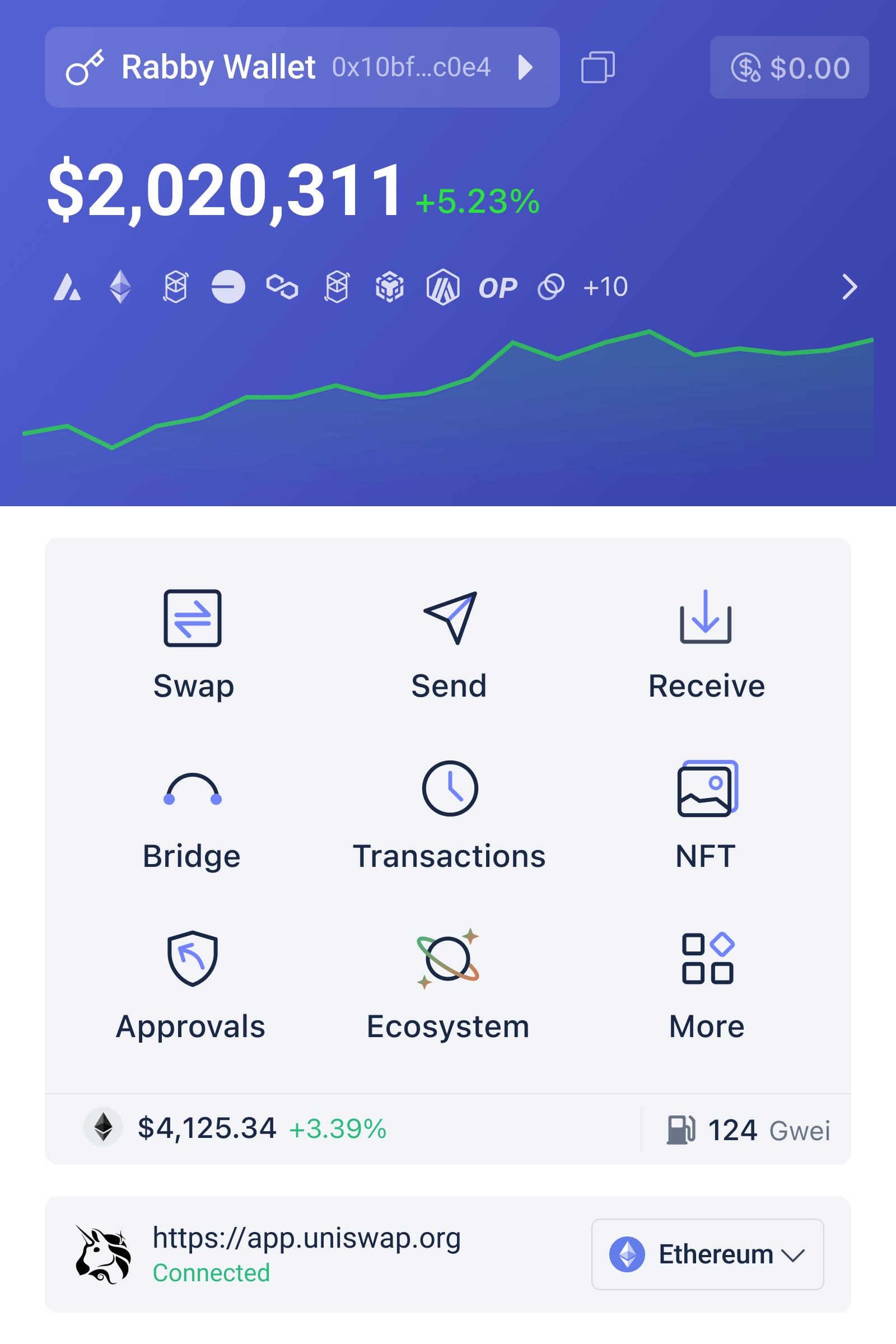
How transaction simulation changed the wallet experience
Early cryptocurrency wallets largely answered one question: can this private key sign the requested message? That model was adequate for simple transfers, but DeFi made the signing prompt much harder to interpret. Users began interacting with automated market makers, lending protocols, liquid staking systems, token approvals, and cross-chain bridges. The visible action might say “approve,” while the economic consequence was that a contract received permission to move a token later.
Transaction simulation adds another layer. Before signing, a wallet can submit a representation of the proposed transaction to an execution environment and observe the resulting state changes. In practical terms, that may include tokens leaving or entering the account, an allowance changing, a contract call reverting, or a transaction failing because of insufficient gas or an invalid parameter. The result is not a prediction in the ordinary sense. It is a conditional execution: what would likely happen if this transaction were executed against a particular recent state.
This is the first important mental model: a simulation is closer to a controlled rehearsal than to an insurance policy. It is useful because it exposes consequences that a raw hexadecimal payload hides. It is limited because blockchains are dynamic systems. Prices move, liquidity changes, blocks are mined, oracle values update, and the contract state may differ between the simulation and the final execution.
For a US-based DeFi user, the practical value is substantial. A simulation may make an unexpected token outflow visible before a signature is given. It may identify that a supposedly simple interaction involves several contract calls. It may also warn that a transaction is likely to fail, helping the user avoid paying network fees for an unsuccessful attempt. These are risk-reduction benefits, not guarantees of a favorable trade or a trustworthy application.
Rabby versus a conventional wallet: a comparison of protection layers
The most useful comparison is not “Rabby is safe and other wallets are unsafe.” It is the difference between a wallet that mainly displays signing data and one that attempts to interpret the transaction’s likely effects. A conventional wallet may be perfectly adequate for sending a known amount of a native asset to a familiar address. For complex DeFi activity, however, raw signing data creates a large information gap between the user’s intention and the contract’s execution.
Rabby’s approach attempts to narrow that gap through transaction simulation and contextual warnings. A user might see an estimated token balance change rather than only a contract address. That encourages a more economically meaningful question: “What will my account hold after this call?” The answer can reveal a mismatch between the website’s button label and the actual transaction. A button saying “claim” should not quietly result in an unfamiliar token approval or a large transfer from the wallet.
The trade-off is that interpretation introduces its own uncertainty. A wallet must identify contracts, tokens, methods, and expected effects. If a contract is new, obfuscated, incorrectly labeled, upgradeable, or interacting with another chain component, the interface may have incomplete context. A clear-looking screen can therefore create overconfidence if the user assumes that every displayed label is independently verified.
Hardware wallets offer a different protection layer. They are primarily designed to keep the signing key isolated from the computer and browser, reducing the impact of some malware and key-extraction attacks. They do not necessarily explain what a complex contract call will do. In a robust setup, a hardware wallet and an interpretive browser wallet are complementary: one protects key custody, while the other helps the user understand the proposed action. Neither resolves the problem of approving a malicious contract after carefully reviewing a misleading interface.
Manual contract review is another alternative. Advanced users can inspect calldata, verified source code, token allowances, protocol documentation, and transaction traces. This can be more rigorous than a wallet summary, but it is slower and requires technical competence. The practical comparison is therefore not between perfect and imperfect tools. It is between different failure modes: a conventional wallet may fail through opacity, a simulation layer may fail through incomplete or stale interpretation, and manual review may fail through human complexity.
What a simulation can reveal in common DeFi scenarios
Consider a token approval. The transaction may not move tokens immediately. Instead, it changes an allowance that permits a spender contract to transfer tokens later. A simulation can help show that an approval is occurring and may indicate the amount or scope involved. This is a non-obvious distinction: the dangerous event may be the permission change, not an immediate balance reduction. Users should pay particular attention to approvals for unfamiliar contracts and to permissions that appear broader than the intended trade.
In a swap, the simulation may show an expected asset leaving the wallet and another asset arriving. It may also indicate a likely failure caused by slippage, an expired deadline, or insufficient balance. But the simulated exchange rate is not a promise. A large pending trade can affect liquidity, and another transaction may execute first. The final result depends on the transaction’s parameters, ordering, liquidity conditions, and the protocol’s implementation.
In lending, the relevant effect may not be a simple transfer. Supplying collateral can alter a borrowing position, liquidation threshold, interest exposure, or available borrowing capacity. Borrowing may increase a liability while depositing an asset changes the account’s risk profile. A simulation that shows token movements is useful, but it may not communicate the full financial risk of a position. Economic interpretation still belongs to the user.
Bridging creates a particularly important boundary condition. A transaction on the source chain may be simulated successfully while the eventual cross-chain delivery depends on relayers, message verification, destination-chain contracts, or a separate claim process. The source-side result does not prove that the whole bridge journey will complete as expected. Users should treat a successful simulation as evidence about one execution stage, not as a guarantee about an entire multi-chain workflow.
Permit-style signatures illustrate another limit. Not every dangerous authorization is a conventional on-chain transaction. Some applications request an off-chain signature that grants a protocol or spender authority to act later. Because no immediate network transaction occurs, the simulation model may be different or less informative. A wallet’s transaction warnings cannot be treated as a universal detector for every form of signed authorization.
Where transaction simulation breaks down
Simulation depends on state. If the simulated state is not identical to the state at execution, the result can change. A token balance may be spent elsewhere, a market price may move, a protocol may reach a utilization limit, or an administrator may upgrade a contract. Even when the transaction itself is unchanged, the surrounding environment can make the outcome different.
There is also a trust boundary around the infrastructure performing the simulation and the data used to label results. A simulation provider, wallet integration, RPC endpoint, or token metadata source may be unavailable, delayed, or wrong. This does not mean the feature is useless; it means its output should be treated as a security signal rather than as authoritative truth. A warning deserves investigation, while the absence of a warning deserves only limited reassurance.
Malicious applications can exploit the gap between a user’s attention and the protocol’s mechanics. A front end may describe an action in friendly language while constructing a different call. A compromised website may request a signature unrelated to the visible task. A simulation can expose some mismatches, especially where the resulting balance changes are clear, but it cannot independently establish that the application’s business purpose is honest or that the contract will remain benign after an upgrade.
For that reason, the strongest workflow is layered. First, confirm that the domain and application are the intended ones. Second, inspect the connected network and account. Third, read the transaction’s stated effects, including approvals and unfamiliar assets. Fourth, compare the result with the action you believe you initiated. Fifth, use a separate signing device or isolated account for meaningful funds when appropriate. Simulation is the middle of this process, not the entire process.
Installing and using the Rabby extension with a disciplined workflow
Users evaluating the browser extension should begin with the source of the installation package, the browser permissions requested, and the authenticity of the download page. If you are comparing installation guidance, this rabby extension download page may serve as a starting point, but users should still verify the official source, inspect the extension publisher, and avoid installing software from unsolicited advertisements or copied search results.
During setup, the recovery phrase is the most sensitive object in the process. It should never be entered into a website, sent to support, stored in an ordinary cloud document, or photographed casually. A browser extension is exposed to the security of the browser profile and the computer on which it runs. Strong device security, separate browser profiles, cautious extension permissions, and a hardware wallet for larger balances can materially reduce the impact of a compromised environment.
After installation, a useful test is to connect a low-value account and perform a familiar action. Observe the network selection, the contract address, the approval request, the simulated balance changes, and the final signing prompt. This creates a personal baseline. When a later transaction differs sharply from that baseline, the discrepancy becomes easier to notice.
Users should also separate accounts by purpose. A wallet used for experimentation with new protocols should not necessarily hold long-term savings or identity-linked assets. This is not because simulation is ineffective; it is because no interface can eliminate every risk arising from phishing, compromised contracts, key theft, signing mistakes, or governance changes. Compartmentalization limits the consequences when a control fails.
What matters now and what to watch next
No recent project-specific news was supplied for the current or latest eligible week, so the more durable issue is the direction of wallet security rather than a newly announced Rabby feature. The category is moving from key storage toward transaction interpretation. That shift is consequential because DeFi risk is increasingly expressed through permissions, composability, and cross-contract behavior rather than through simple transfers.
A plausible next step is more continuous monitoring of allowances, contract upgrades, chain context, and post-signature activity. Whether that becomes genuinely useful will depend on accuracy and on whether warnings remain comprehensible rather than turning into alert fatigue. The signal to watch is not the number of warnings a wallet produces, but whether users can distinguish a routine risk from a transaction that conflicts with their stated intention.
The central lesson is therefore narrower and more practical than “use a secure wallet.” Treat transaction simulation as an observability tool. It helps translate contract execution into consequences a person can inspect, especially token movements and permissions. Then ask what the simulation does not cover: future state changes, off-chain signatures, cross-chain completion, upgrade authority, and the trustworthiness of the application itself. That combination of visibility and skepticism is more durable than relying on any single security feature.
Frequently asked questions
Does Rabby transaction simulation guarantee that a DeFi transaction is safe?
No. It can reveal likely effects and identify some failures or suspicious outcomes before signing, but it depends on available state, contract interpretation, and infrastructure. It cannot guarantee that a protocol is honest, that a future state will remain unchanged, or that a cross-chain operation will complete successfully.
Is transaction simulation a replacement for a hardware wallet?
No. The two tools address different risks. Simulation improves understanding of what a transaction may do, while a hardware wallet helps keep signing keys isolated from the browser and computer. Using both can create stronger defense in depth, although neither protects against every form of phishing or deliberate approval of a malicious contract.
What should I do if the simulated result does not match my intention?
Do not sign immediately. Check the application domain, network, recipient, contract address, token approval, and requested signature. If the discrepancy remains unexplained, reject the request and investigate through an independent source. A confusing or unexpected simulation is a reason to pause, not an obstacle to click through.