
Imagine moving funds from Ethereum to a layer-2 network before joining a DeFi pool. You choose a bridge, approve a token, sign a transaction, and only afterward discover that the approval was broader than intended or that the final asset received differs from what you expected. The danger is not necessarily a dramatic hack. More often, it is a small failure of interpretation at the exact moment a user authorises irreversible code.
That is the problem Rabby Wallet tries to address. It is a non-custodial wallet developed by DeBank for Ethereum and other EVM-compatible networks, with an emphasis on showing what a transaction is expected to do before the user signs it. For German-speaking DeFi users, its appeal is therefore not simply the number of supported chains. The more important question is whether the wallet can reduce decision errors without encouraging excessive confidence.
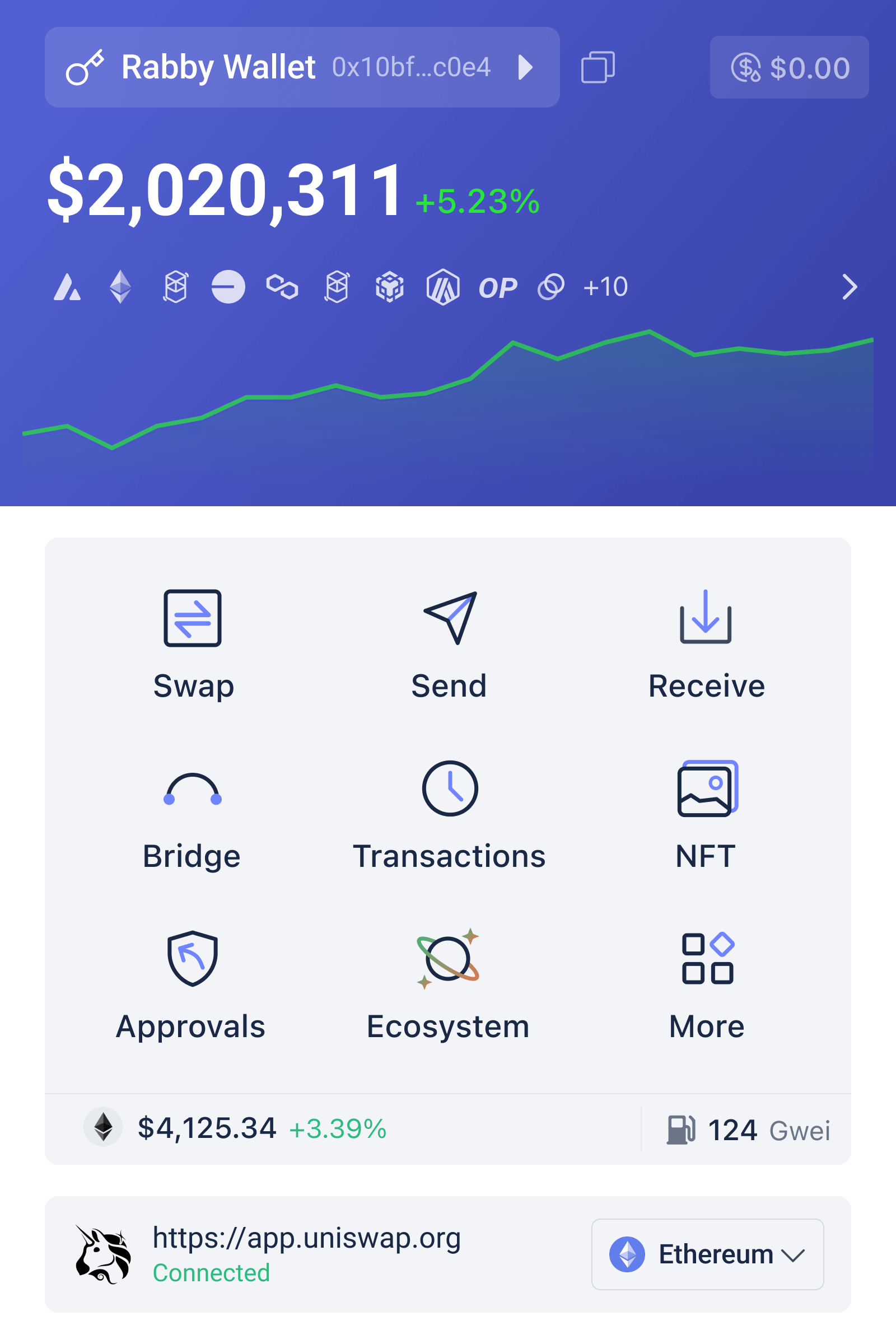
The first misconception: a safer interface is not the same as safe DeFi
Rabby is often understood as a more security-conscious alternative to MetaMask. That comparison is useful, but incomplete. A wallet is an interface and signing environment; it does not eliminate the economic, technical, or governance risks of the protocols to which it connects. A simulation may show that a user will receive a token and spend another token, while leaving broader questions unresolved: Is the protocol audited? Is its oracle reliable? Can its administrators change critical parameters? Is the token itself legitimate and liquid?
Rabby’s security model operates at a narrower but highly practical layer. Its integrated scanner checks contracts and addresses for signals associated with phishing, known compromises, and potentially dangerous approvals, including infinite token allowances. Its transaction simulation then attempts to make the expected state change visible before confirmation. This distinction is important: the wallet can improve verification of an action without guaranteeing the quality of the application behind it.
That is still meaningful. In an EVM transaction, the user is not merely sending money; they may be authorising a contract to call functions, transfer tokens, or alter a position. Human-readable labels and simulated balance changes can expose a mismatch between the user’s intention and the transaction’s apparent effect. The mechanism is best viewed as a second set of eyes, not as an automated investment adviser.
How transaction simulation changes the signing decision
A conventional wallet often presents a request that is technically accurate but cognitively difficult to interpret. Contract addresses, method names, hexadecimal data, and network identifiers are not a reliable decision interface for most people. Rabby’s pre-signing simulation tries to translate the request into consequences: which balances are expected to decrease, which assets should arrive, and what permissions may be granted.
This creates a useful mental model for users: first identify the intended economic result, then compare it with the simulated result, and only then consider the signature. For example, if a user expects to deposit USDC into a lending protocol, a simulation showing an unexpected token transfer, a large approval, or no recognisable position change deserves a pause. The wallet does not need to prove malicious intent for the warning to be useful; an unexplained deviation is already a risk-management signal.
There are limits. Simulations depend on the state of the relevant network and on the ability of the analysis system to interpret the transaction. Complex DeFi operations, unusual contract behaviour, changing market conditions, failed execution paths, or interactions across protocols can make the displayed outcome incomplete or difficult to evaluate. A transaction that looks normal can still interact with a vulnerable contract. Conversely, a warning can reflect uncertainty rather than confirmed fraud. The correct response is investigation, not blind approval or blind rejection.
Multi-chain convenience creates a new control problem
Rabby supports more than 140 EVM-compatible networks, including Ethereum, Polygon, Arbitrum, Optimism, Avalanche, Base, and BNB Chain. It can also detect the network required by a decentralised application and switch automatically. This removes a common source of friction, especially when users move between applications in the German DeFi ecosystem and compare fees across networks.
Yet automatic network switching has a trade-off. Manual network selection is inconvenient, but the inconvenience can remind a user where funds are held and which chain a transaction affects. Automation reduces clicks while also reducing deliberate pauses. For that reason, a disciplined user should still check the chain, asset, recipient, and application domain before signing. A smoother interface can lower operational mistakes, but it can also make rapid, unreflective signing easier.
The same principle applies to bridges. Rabby integrates bridge routes such as LI.FI, allowing users to move assets across networks from within the wallet interface. This is operationally attractive because users do not need to visit several separate services. However, bridging introduces additional assumptions: the route may involve more than one protocol, fees and exchange rates can change, and the security of the destination depends on the bridge and the receiving application. Consolidating the workflow does not consolidate the underlying risk.
Swaps, gas accounts, and the economics of convenience
Rabby’s integrated swap function can scan decentralised exchanges such as Uniswap and 1inch to seek competitive execution and lower slippage. Slippage is the difference between the expected and actual exchange price, often caused by limited liquidity or market movement. Aggregation may improve route selection, but “best rate” is never a permanent property. The result depends on liquidity, fees, price impact, gas costs, and the exact moment of execution.
The Gas Account feature addresses another practical barrier: users may hold USDC but lack the native token required to pay a network’s transaction fee. Paying gas with stablecoins across networks can reduce the chance of being stranded with unusable balances. It also makes onboarding simpler. The boundary condition is straightforward: the feature does not make transactions free, and availability, conversion terms, and supported networks remain relevant. Users should treat it as a payment convenience rather than a change to the underlying fee market.
Rabby Points, earned through activities such as swaps, gas top-ups, or referrals, add a loyalty layer. Such incentives may encourage exploration, but they also create a behavioural risk familiar from other digital platforms: users can begin optimising for points rather than for sound transaction selection. Points should never justify a trade, bridge, or approval that would otherwise fail a security and cost assessment.
Custody, hardware, and the user’s real security perimeter
Rabby is non-custodial. Private keys are stored locally on the user’s device and are not sent to Rabby’s servers. The wallet also supports hardware devices such as Ledger, Trezor, and OneKey. This architecture changes who carries the final responsibility: Rabby cannot recover a lost seed phrase, reverse an unintended signature, or compensate a user who authorises a malicious transfer.
Hardware signing can reduce exposure of the private key, but it does not automatically make a transaction correct. A user can still approve the wrong contract or confirm a harmful operation on a hardware device. The strongest workflow combines several controls: use a separate wallet for experimentation, keep long-term holdings away from routine dApp activity, verify the application domain through an independent channel, review approvals, and use hardware signing for higher-value accounts.
Rabby’s open-source MIT-licensed architecture allows community inspection of the software, which is a valuable transparency property. It is not, however, a guarantee that every dependency, release process, browser environment, or user device is risk-free. Open source improves the possibility of review; it does not replace review or operational hygiene. The same applies to Rabby’s partial independence from its backend: core signing functions can remain available during service interruptions, but analysis, warnings, network data, and route information may depend on external infrastructure.
A reusable framework for German DeFi users
Before signing through any wallet, apply a four-part check. First, verify context: the correct chain, dApp, account, and asset. Second, verify intent: what economic action are you trying to perform? Third, verify effect: do the simulation and approval details match that intention? Fourth, verify exposure: how much value, permission, and future access are you granting?
This framework is more durable than memorising a list of supposedly safe applications. It also helps separate two types of risk. Interface risk concerns misunderstanding what a transaction does. Protocol risk concerns whether the contract behaves safely and fairly after it has been authorised. Rabby can meaningfully reduce some interface risk; it cannot remove protocol risk, market risk, bridge risk, or the consequences of poor key management.
For readers looking to install or evaluate the browser-based product, the rabby wallet extension should be obtained only through a trusted, verified distribution path, with the publisher and requested permissions checked carefully. This is especially important because phishing pages frequently imitate wallet brands and attempt to capture seed phrases or induce fraudulent approvals.
What to watch next
The recent Chrome Web Store description continues to position Rabby as an open-source Ethereum and EVM wallet designed for a smoother multi-chain DeFi experience. The important development signal is not merely broader availability. It is the direction of wallet design: wallets are increasingly becoming transaction interpreters, route selectors, bridge interfaces, and risk dashboards rather than passive key containers.
If this direction continues, the decisive question will be whether added automation remains inspectable. Features such as automatic network switching, aggregated swaps, and stablecoin gas payments can reduce friction, but trust will depend on clear explanations of routes, fees, permissions, and uncertainty. The best wallet is therefore not the one that makes signing invisible. It is the one that makes the consequences visible without overwhelming the user.
Frequently asked questions
Is Rabby Wallet safer than MetaMask?
It offers a different security-oriented user experience, including transaction simulation, risk warnings, and strong multi-chain tooling. That may reduce certain interpretation errors, but it does not make protocols, bridges, devices, or user decisions risk-free. The comparison should focus on workflow and controls rather than on an absolute safety ranking.
Can Rabby protect funds if a user signs a malicious transaction?
It may warn about suspicious addresses, contracts, or approval patterns, and the simulation may reveal unexpected balance changes. However, warnings are not perfect and a user can still approve a harmful transaction. Once a valid signature authorises an on-chain action, recovery may be impossible.
Does paying gas with USDC remove the need to hold native tokens?
The Gas Account feature is designed to let users pay supported network fees with stablecoins such as USDC, even when they lack the chain’s native token. It reduces a common usability problem, but users should still check availability, fees, supported networks, and the exact conversion conditions at the time of use.
What is the most important habit when using a DeFi wallet?
Do not sign from the requested action alone. Compare the application’s purpose with the simulated outcome, inspect approvals and recipients, confirm the network, and consider whether the amount and permission are proportionate to the task. This habit remains useful regardless of which wallet interface is selected.